
Why Reactive Safety Fails — And What Leading Businesses Are Doing Instead
Pioneering the future of industrial intelligence through AI and IoT innovation
Why Reactive Safety Fails — And What Leading Businesses Are Doing Instead
Workplace safety has a visibility problem
Most safety teams don’t fail because they don’t care. They fail because the systems they’ve been given can’t see what they need to see — until after harm is done.
This is the defining limitation of reactive safety. And it’s why three thousand hazards can sit in plain sight at any industrial site, every single day, while the safety team focuses on documenting the one that finally caused an injury.
The triangle most safety leaders already know
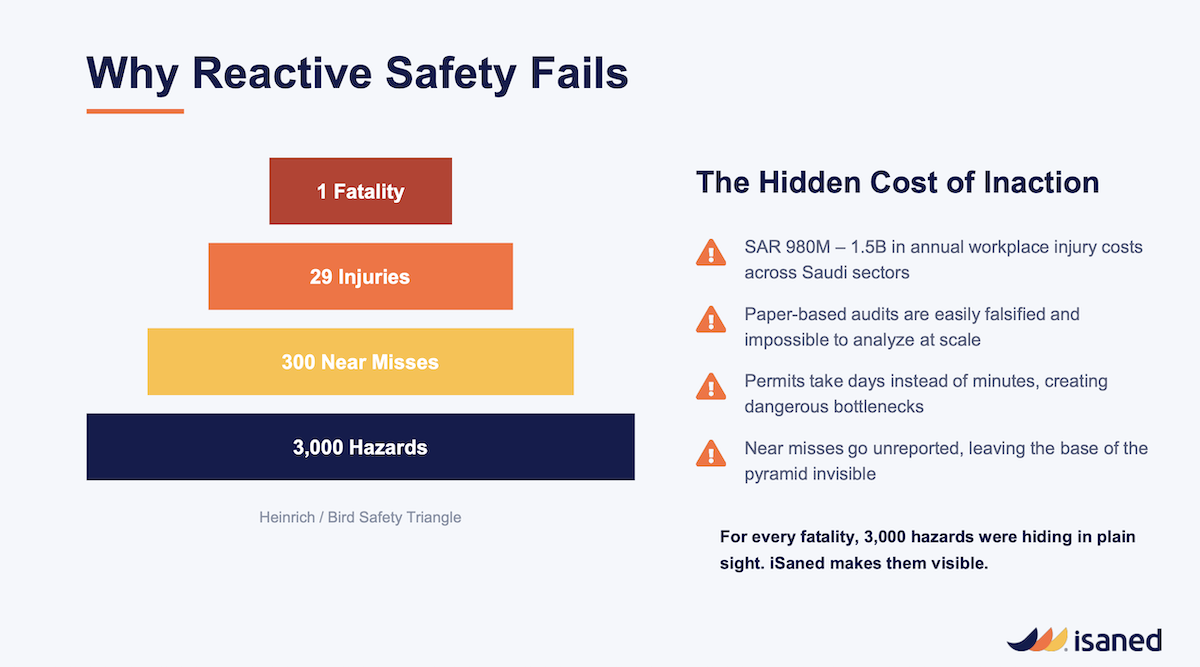
The Heinrich/Bird Safety Triangle is one of the most cited frameworks in industrial safety, and for good reason. It maps a hard truth about how harm happens.
For every 1 fatality at an industrial site, the data shows roughly:
- 29 injuries
- 300 near misses
- 3,000 hazards — unsafe acts or unsafe conditions
The math is uncomfortable. For every catastrophic incident at a site, three thousand hazards were already there, distributed across shifts, locations, and routine operations. Most went unreported. Most were undocumented. Most were invisible to the people responsible for preventing the next one.
This is what reactive safety looks like in practice. The pyramid is upside down — you only see the top, and only after harm has occurred. The wider, more important base of the pyramid stays hidden.
Why reactive safety persists?
It’s not because safety leaders haven’t tried. The persistence comes from the tools. And the tools haven’t kept up with the pace, complexity, or scale of modern industrial operations. Audits on paper or a spreadsheet are easily backdated, hard to verify, and impossible to analyze at scale. By the time a pattern is visible, the pattern has already cost something.
Permit-to-work approvals that take days create dangerous bottlenecks. Workers either wait — losing operational hours — or proceed without proper sign-off, hoping nothing goes wrong.
Near-miss reporting that requires effort is reporting that doesn’t happen. Without a fast, mobile, anonymous way for any worker to flag a hazard the moment they see it, the base of the safety triangle stays invisible.
Incidents that get logged once and forgotten repeat themselves. Without centralized action tracking, the same root cause produces the same incident again at a different site, with different people, six months later.
The result is safety teams spending most of their time documenting what already happened, instead of preventing what’s about to.
Industrial safety has gone through three eras
The first era standardized safety on paper. Pen-and-paper audits, traditional checklists, and foundational regulations like OSHA. Work moved from chaotic to standardized. That was the leap.
The second era moved safety online. SaaS platforms started replacing paper. Workflows became searchable. Reporting got better. The leap there was speed.
The third era — the one happening now — converges AI, machine vision, IoT sensors, and real-time analytics into something fundamentally different. Not a digital version of paper. Not a slightly faster spreadsheet. A connected, predictive, proactive ecosystem where safety is embedded into operations rather than reported on afterward.
Most safety teams are still operating in the second era. The leading ones have already moved to the third.
What proactive safety actually looks like
Three concrete shifts separate reactive teams from proactive ones.
Speed instead of paperwork
Digital permit-to-work compresses what used to take days into minutes. Job Safety Analysis is built into the permit. Risk identification happens before approval, not after an incident. Workflows route to the right approvers automatically. Operations don’t wait. Compliance doesn’t slip.
But the deeper problem with paper isn’t approval speed. It’s that data gathered slowly is data that never becomes insight.
By the time spreadsheets are consolidated, audits are typed up, and incident logs are reconciled at month-end, the conditions that produced them have already shifted. The team isn’t analyzing the present — they’re autopsying the past. Patterns that should have triggered intervention three weeks ago surface in a quarterly review, if at all.
Proactive safety closes that loop in real time. Data captured at the source, in the moment, by the person who saw it — flowing into a system that’s already analyzing it before the next shift starts.
When data collection is instant, insight stops being a project. It becomes the default state of the system.
Visibility instead of reports
The traditional safety dashboard is a graveyard of raw data. Charts that need interpreting. Tables that need filtering. Reports that need reading. The work of turning data into meaning falls back on the safety leader, on top of everything else they’re already responsible for.
Proactive safety inverts that.
iSaned captures data continuously across every part of the operation — audits, permits, near-miss reports, action trackers, sensor streams — and does the analysis in the background, around the clock. The platform doesn’t hand you a spreadsheet and ask you to find the pattern. It surfaces the pattern.
What the safety leader sees, 24/7, isn’t data. It’s the answer.
Which sites are trending toward higher risk this week. Which audits are being closed too quickly to be credible. Which contractors are accumulating near misses. Which equipment is overdue for inspection. Which corrective actions have stalled. Which leading indicators are moving in the wrong direction before the lagging ones do.
The job stops being to find the signal in the noise. The signal arrives already isolated, already prioritized, already actionable. The safety leader’s attention goes where it actually matters — to the decisions only a human can make — instead of being burned on the work of producing the report itself.
That’s what visibility means in the third era. Not more data. Less data. Just the right data, surfaced at the right moment, ready to act on.
Connection instead of silos
The hazards that cause incidents rarely live in one system. A worker without proper PPE, a fire suppression sensor reading abnormal pressure, a contractor with three open near misses, a permit approved without the right checks — each is a fragment. The danger lives in the combination.
Reactive safety leaves these fragments scattered across cameras, control rooms, paper logs, and disconnected applications. No one ever sees them in the same place. Proactive safety connects them.
AI-powered video analytics turns existing CCTV cameras into another sensor in the system, flagging missing PPE, restricted-zone breaches, and unsafe behaviors the moment they happen. IoT monitoring of critical safety systems — fire detection, suppression, thermal anomalies — runs continuously, without waiting for a scheduled inspection to confirm something’s wrong.
The fire system use case makes the cost of disconnection visceral. According to the NFPA, sprinklers operate in 92% of fires that activate them. The 8% that fail account for catastrophic losses of life and property. Almost every failure traces back to the same issue: maintenance was overdue and no one knew. The sensor existed. The data existed. It just wasn’t connected to anyone who could act.
Real-time monitoring closes that gap entirely. The system tells you it’s at risk before the fire, not during it. And it does it across every connected system, simultaneously, without anyone having to ask. When everything is connected, the fragments stop being fragments. They become a complete picture — and the picture is being watched, even when no one is looking.
“Proactive by design” — not by accident
Proactive safety isn’t a stretch goal you reach by working harder with the same tools. It’s a property of the systems you put in place.
When audits are digital and verified in real time, falsification stops being possible. When near-miss reporting is one tap from any worker’s phone, the base of the triangle becomes visible. When the platform analyzes everything in the background, insight stops being a chore and becomes a constant. When IoT and AI watch what humans can’t watch continuously, the failures that were going to happen anyway get caught before they matter.
For every fatality, three thousand hazards were hiding in plain sight.
The job isn’t to react faster when one of them surfaces. The job is to make all of them visible — and to give the people on the ground a system that’s already analyzing what it sees, the moment it sees it. That’s what the third era of safety looks like. And it’s already running at industrial sites that decided not to wait for the next incident before changing how they operate.
Want to see what proactive safety looks like on your operations?
Book a 20-minute demo with the iSaned team.


